Reusable Documents for Working Teams
A working form has two jobs: preserve the approved content and make the next person’s input clear.
Discuss a Document System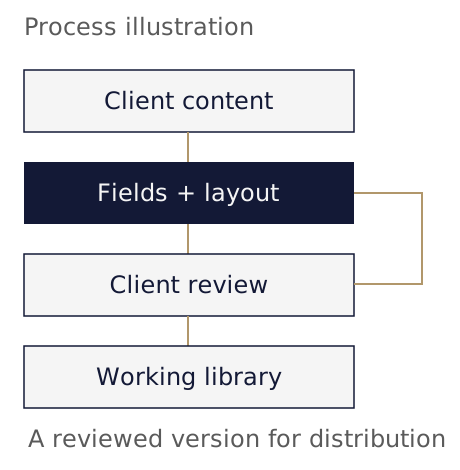
The Working Brief
Client teams had existing documents that needed the right branding and places for people to enter information. Some needed editable working files. Others needed fillable PDFs. The assignment extended from reusable document layouts to revisions of individual forms, with the client responsible for deciding which copy entered its working library.
The source material already contained substantive requirements. InterSculpt handled layout, brand treatment and form production; client engineering, legal and safety teams supplied and reviewed the content. That division mattered throughout the work, particularly when a request involved an existing legal document or a form with operational instructions.
A request to brand a supplied form and add prompted fields provides the clearest example. It passed through production, client acceptance and upload to the client’s library. A related document then required an entity-specific correction. These were separate steps with separate versions, even though they belonged to the same working correspondence.
Production Decisions
Supplied Content and Reusable Layouts
The broader delivery included letterheads and reusable document shells, along with editable templates and expense forms. Those files established a recurring production scope: client material arrived with a purpose and an owner, and InterSculpt gave it a usable document format and the intended brand treatment.
An editable master and a fillable PDF met different needs. The master supported later changes to the document itself. The PDF provided a version with designated entry areas. Both formats appeared in the delivered work; the choice depended on the requested document and its intended use.
Delivery RecordThe delivery record lists reusable layouts and editable templates; the client acknowledged receipt.
Prompted Entry Fields
The client supplied a form and asked for branding plus fillable insertion areas. InterSculpt returned an editable document and a PDF. Production focused on distinguishing the document’s fixed content from the information a person would need to enter.
The client accepted that delivered form. The substantive language remained the client’s responsibility throughout: making a document fillable did not transfer approval of its terms to the studio.
This request made form behavior part of the deliverable. A branded header alone would have left the request incomplete. The requested entry areas had to be included in the versions returned for review.
Delivery RecordThe request, paired delivery and client acceptance are recorded in the same correspondence.
Entity-Specific Revisions
A related document went through an additional correction after editable and PDF versions had been supplied. The reviewer requested information for the intended organization only. InterSculpt returned a corrected pair of files.
That revision concerned which organization appeared in the document. It belonged in both delivered formats. Keeping the editable file aligned with the PDF was part of applying the correction, since either could become the starting point for the next request.
Delivery RecordA final client instruction requested one organization’s information; InterSculpt supplied corrected editable and PDF versions.
Library Handoff
After accepting the fillable form, the client confirmed that it had been uploaded to the working library. The same message said the link would be circulated. Upload was complete; circulation was the client’s stated next step.
The handoff therefore had a named owner on the client side. InterSculpt supplied the file, while the client placed it in the location used for distribution. The library copy and the link to it were part of the client’s document administration.
Later delivery records included further revisions and a library structure for assets, document kits and forms. Those records describe the continuing production work. They do not establish how many people opened, completed or reused any particular file.
Delivery RecordThe client confirmed the upload and described planned link circulation separately.
Continuing Form Requests
Later requests extended the work to additional supplied PDFs that needed updated marks and fillable behavior. InterSculpt returned the revised forms, and the client acknowledged them. This was a continuation of the same division of work: supplied content, production changes and client review.
The recurring requests show how the document assignment developed beyond an initial template delivery. New forms and corrections continued to arrive. Each needed the right source document, the intended organization’s details and a returned version the client could review.
Delivery RecordSubsequent request and delivery correspondence records new fillable forms and client acknowledgment.
The Delivered Work
InterSculpt delivered reusable layouts, editable documents and fillable PDFs. The clearest completed handoff is the individual form the client accepted and uploaded to its working library. Related corrections and later form requests continued the production relationship.
Practical Lessons
- Identify who owns the wording before production begins. A studio can apply approved content and build entry fields while the appropriate client team retains substantive approval.
- Treat an entity correction as a revision to the whole delivered set. Check the editable master and PDF together before either is reused.
- Distinguish file delivery, library replacement and link circulation. Assign each handoff to a person and record its actual status.
Project Contributions
Client teams supplied and reviewed engineering, legal and safety content. InterSculpt produced the layouts, brand treatments and form fields.